
Guide to Terminals and Concourses of Atlanta Airport (ATL)
Quick Answers about ATL Terminals
- ✈️ How many terminals does Atlanta Airport have? Two main buildings: the Domestic Terminal and the International Terminal, which provide access to 7 concourses (T, A, B, C, D, E, F).
- 🚆 How to move between concourses? The Plane Train is the fastest option: it operates 24 hours with a frequency of approximately every 2 minutes and features new cars added in 2026, quieter and with better onboard information. Keep in mind that at night the frequency may decrease on some stretches. Important: upon arrival from an international flight, you cannot use it to go directly to the domestic terminal; you must use an external shuttle.
- 📍 Which concourse is closest to the main security checkpoint? Concourse T is directly connected to the Domestic Terminal atrium.
- ⏱️ When do most security delays occur? The busiest hours at TSA checkpoints are from 5 to 9 am and from 4 to 8 pm. Long waits are one of the most frequent complaints throughout the airport, regardless of the concourse. If you can avoid those hours, better.
- 🍽️ Which areas have the most services? Concourses B, C, E, and F have the highest concentration of restaurants and shops, although many users warn that most establishments close early at night.
- 🛋️ Are there VIP lounges in all concourses? Yes, but be prepared for possible waits. Reviews indicate that VIP lounges, especially Delta's, tend to be crowded with waiting lists. In 2025, the new Delta Sky Club opened in Concourse D, the largest in the airport, which has somewhat improved the situation in that area.
- ♿ How is accessibility? Although infrastructure exists, assistance is very inconsistent. Many travelers with reduced mobility report serious failures in the wheelchair service and signage that could be improved.
Estimated Walking Times (from Plane Train to furthest gate)
- Concourse T: 2–5 minutes
- Concourse A: 5–10 minutes
- Concourse B: 6–12 minutes
- Concourse C: 7–15 minutes
- Concourse D: 8–18 minutes
- Concourse E: 10–20 minutes
- Concourse F: 10–15 minutes
Critical Points: Smart Traveler's Manual
Security lines: the point of greatest friction
User experience:
Waits at TSA checkpoints are the most repeated complaint at ATL, regardless of concourse or time. Several travelers report having arrived with enough time and still having to run to their gate. The lack of staff in lanes that should be open is a recurring problem, especially during peak hours.
Strategy: Signing up for TSA PreCheck or CLEAR is the decision that has the biggest impact on the security experience at ATL. If you don't have either, add at least 30 extra minutes to your usual margin, and up to an hour on high-demand days or holiday seasons.
International to domestic connections: the most complex stretch
User experience:
The transition between an international flight and a domestic connection is one of the most criticized processes at the airport. The traveler must go through Immigration, pick up luggage, go through Customs, and check in again before being able to access the Plane Train towards the domestic concourses. Many describe this route as confusing, poorly signposted, and with unhelpful staff.
Strategy: For international-domestic connections, calculate a minimum margin of 90 minutes. If your connection is tighter, check with the airline before traveling about available options.
Distances and walks: ATL is longer than it seems
User experience:
ATL concourses extend in a straight line for over a mile and a half. Several travelers mention underestimating walk times, especially in Concourse E, where the furthest gates involve a long walk without moving walkways on some stretches. Concourse D, currently under construction, adds additional friction due to the narrower passage and construction environment.
Strategy: Always use the Plane Train to move between concourses. To get from the station to your gate, check the airport map before getting off the train and calculate between 5 and 20 additional minutes depending on the concourse.
Staff: the most variable factor of the experience
User experience:
ATL reviews show a very clear pattern: staff can completely transform the experience, for better or worse. In the same concourse and on the same day, one traveler may find someone exceptionally friendly and another completely indifferent or rude. The points of greatest reported variability are airline counters, TSA checkpoints, and information points.
Strategy: If you need assistance, actively look for guidance staff, who are usually near the concourse entrances and in the central atrium. In case of inappropriate treatment, you can report it at the airport's feedback kiosks or through the official app.
Temperature and comfort: areas to consider
User experience:
Several travelers point out that some areas of the airport, especially in Concourse T and certain areas of Concourse D during construction, can feel very hot or uncomfortable for long waits. The lack of seating in high-demand areas is also a frequent complaint.
Strategy: If you have a long wait, concourses B, C, and E offer more comfortable seating options and more stable temperatures. Concourse F is usually quieter and cooler outside international flight hours.
What to Expect When Navigating ATL Terminals: A Game of Contrasts
Atlanta Airport is a logistics giant. Its design, with a Domestic and International Terminal feeding 7 parallel concourses, is built for efficiency. The Plane Train is praised almost universally as a brilliant system for moving quickly between concourses. However, the traveler's experience is a true game of contrasts.
While the overall organization and signage receive good ratings, be prepared for its most reported weaknesses: security wait times that can be chaotic, staff attitudes that vary from incredibly friendly to extremely rude, and inconsistent cleanliness between different areas. The key is to arrive with plenty of time and patience.
Image
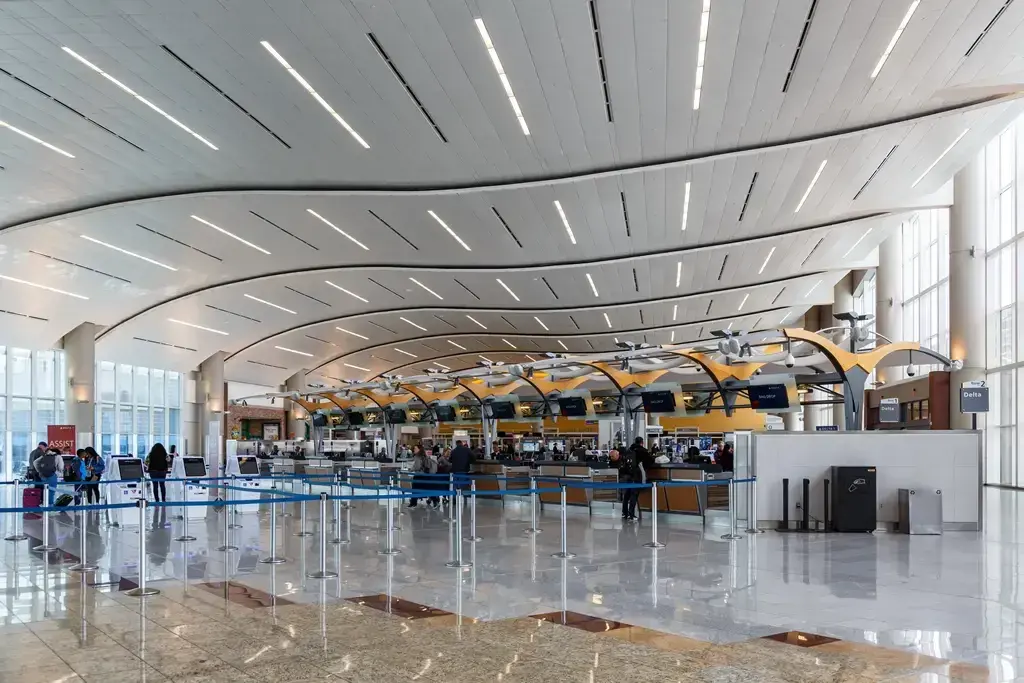
Photo by Boarding1Now - Istockphoto
Domestic Terminal
The Domestic Terminal is divided into North and South sectors, each with its own check-in counters and baggage claim. Delta Air Lines dominates the South sector, while other airlines such as Southwest, United, and Spirit operate from the North. The central atrium connects both sides.
Concourse T
It is the closest to the main security checkpoint and houses VIP lounges from Delta, American, and United. Although convenient due to its location, some travelers report that it can feel dirty or neglected compared to other areas, with occasional complaints of bad odors and lack of cleanliness. It is also the concourse with the greatest variability in staff quality according to recent reviews.
Concourse A
One of the busiest concourses, operated almost entirely by Delta. Despite high traffic, travelers value its Delta Sky Club, recently improved and considered by many frequent travelers as the best in the ATL system, highlighted for its attentive staff and more manageable environment than other locations.
Concourse B
Also dominated by Delta, it is known for its good selection of shops and services. It is home to Fresh To Order, the highest-rated dining establishment at the airport according to recent reviews, not only for its food but for the exceptional service of its staff, especially Ronald, who has become a reference among regular travelers.
Concourse C
A central concourse with good connections and a solid gastronomic offering. Here you'll find Varasano's Pizzeria, whose live piano atmosphere is a respite from the airport's usual rhythm, and Bantam & Biddy, very popular for its Southern food and gluten-free options. The Delta Sky Club C, although often crowded, has recently been improved and remains one of the most complete in terms of food offerings within the system.
Concourse D
This concourse is currently undergoing renovation: ongoing works will considerably expand its width, height, and overall comfort. In the meantime, passage may feel narrower than usual and the construction environment affects the experience. Good news for VIP lounge users: the new Delta Sky Club D, opened in 2025, is the largest in the airport, with capacity for over 500 people and panoramic views, a very notable improvement over what was there before.
User experience:
Recent reviews describe Concourse D as functional but with the friction typical of a space under construction. It is recommended to calculate extra time if your gate is in this concourse.
Concourse E
Handles a mix of domestic and international flights, giving it a quieter atmosphere. It is home to high-end options like the One Flew South restaurant and the exclusive American Express Centurion Lounge, considered by many travelers as the best lounge at the airport. However, be prepared to walk: gates at the ends of this concourse are among the furthest and the absence of moving walkways on several stretches is a frequent point of friction in reviews.
User experience:
The Centurion Lounge in this concourse generates waiting lists of up to 50 minutes during peak hours. If you have access, it's worth joining the online list before reaching the lounge door.
Maynard H. Jackson Jr. International Terminal
Concourse F
Exclusive for international flights, this concourse offers a modern environment, with 12 gates, shops, restaurants, and rest areas. It is distributed across multiple levels: on the lower levels are the arrival areas, immigration controls, and access to the Plane Train; on the upper levels are the boarding points and VIP lounges.
- Delta Sky Club F (usually open until midnight; one of the few with an outdoor non-airside terrace to get some air between flights)
- Minute Suites (with 24-hour access, although travelers report unexpected closures; the staff of this concourse receives very good ratings)
- The Club at ATL (accessible with Priority Pass and Capital One Venture X, but with waiting lists that can exceed two hours on high-demand days; for short layovers, practically inaccessible)
Despite its modern design, the experience in Concourse F is marked by criticism of the arrival process. Travelers who end their journey here or connect to a domestic flight face a customs control that many describe as chaotic and with unfriendly staff. Subsequently, they must collect their luggage, re-check in if continuing their journey, and face the confusing and slow external shuttle connection to reach the Domestic Terminal, MARTA, or ground transportation.
User experience:
According to recent reviews on Google Maps and travel forums, the international-domestic connection process at ATL is one of the most criticized among major US hubs. Signage after Customs has improved, but the external shuttle stretch still generates confusion, especially for travelers visiting ATL for the first time.
Strategy: If you arrive on an international flight and have a domestic connection, once in the Customs area, follow the signs to "Domestic Connections" and not to the general exit: they are different routes. If your flight crew can guide you before landing, even better.
See more about Terminal Connection
Pros and cons of ATL terminals
Pros: linear design easy to understand once known; renovated, frequent, and free Plane Train; wide gastronomic and service offering in concourses B, C, and E; good connectivity with MARTA and ground transportation; new Delta Sky Club D, the largest in the airport; Centurion Lounge in Concourse E as a quality reference among lounges.
Cons: unpredictable and often long TSA lines; complex and poorly signposted international-domestic connection; very inconsistent staff depending on the concourse and shift; Concourse D with temporary discomfort due to ongoing works; long distances in Concourse E without moving walkways on all stretches; crowded VIP lounges with waiting lists during peak hours.
